
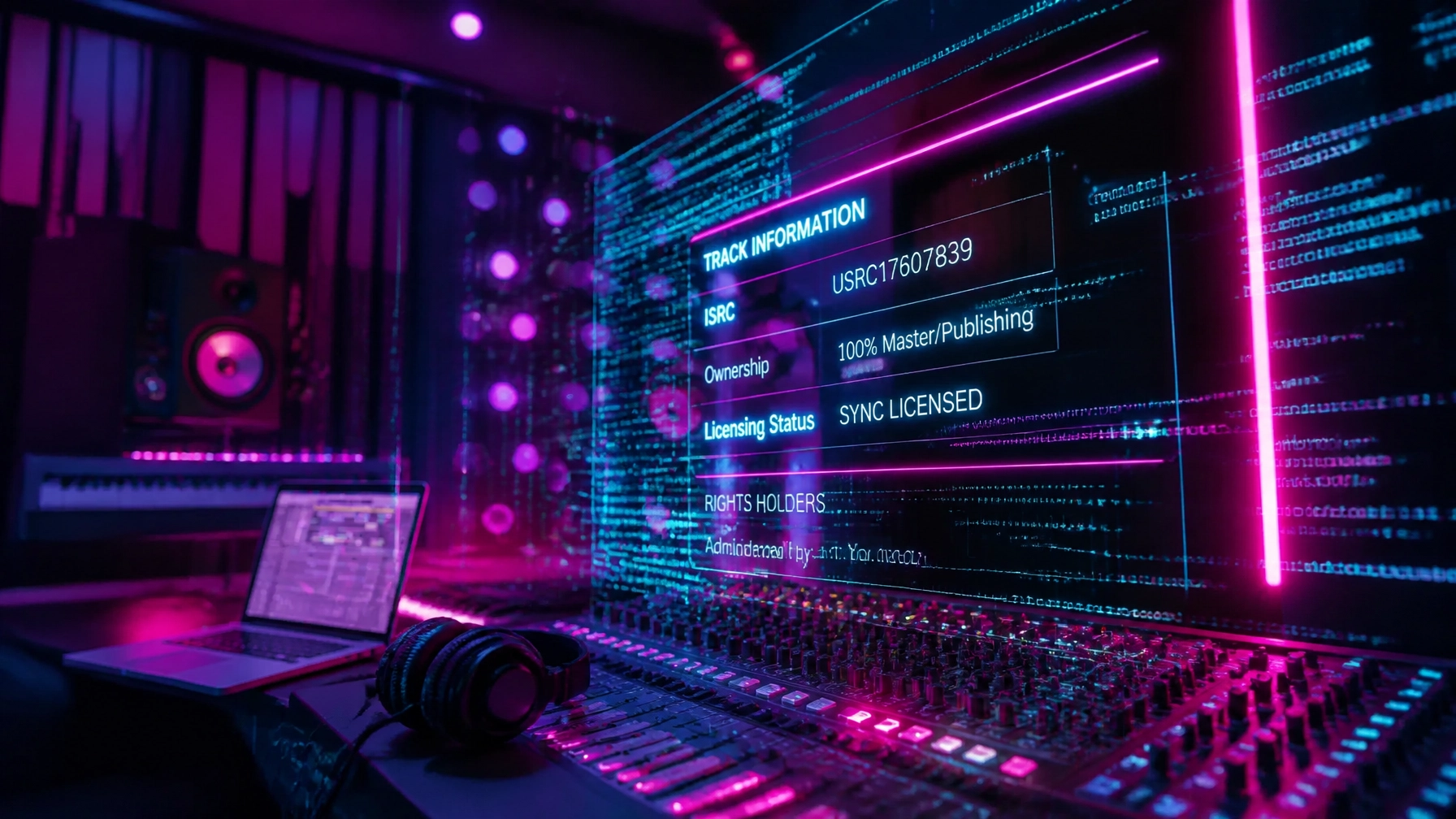

In the modern music economy, a song is no longer merely an arrangement of frequencies or an emotional transmission; it is a complex packet of digital intelligence. We often speak of the "soul" of a track: the intangible magic that makes a listener weep or a brand’s message resonate: but in the sterile, high-velocity world of sync licensing, that soul is effectively invisible without its digital skeleton. This skeleton is metadata.
Metadata is the unseen architecture of the music industry. It is the silent record of who wrote the melody, who owns the recording, and where the money should flow when that music meets an audience. Yet, despite its critical importance, it remains one of the most neglected aspects of the creative process. This neglect carries a profound, often catastrophic, hidden cost. To ignore metadata is to allow your art to drift into the void, untraceable and uncompensated.
The Labyrinth of Lost Income
The most immediate and painful consequence of poor metadata is the "black box." Every year, hundreds of millions of dollars in royalties sit in unallocated pools within Performance Rights Organizations (PROs) and Collective Management Organizations (CMOs). This is not because the music isn't being played, but because the data attached to the usage does not match the data in the registry.
When a track is licensed for a television show or a film, a cue sheet is generated: a document that serves as the official record of music usage. If your ISRC (International Standard Recording Code) or ISWC (International Standard Musical Work Code) is missing, or if your name is misspelled, the system fails to bridge the gap between the broadcast and your bank account. These "black box" royalties are eventually redistributed based on market share, meaning the independent artist’s hard-earned revenue is essentially donated to the industry's largest players.

This is a form of financial atrophy. We see creators pouring thousands of dollars into studio production and mastering, only to lose ten times that amount over a decade because they failed to embed their ownership details into the file itself. In an era where every cent of passive income counts, bad metadata is a hole in the bottom of your financial vessel.
The Music Supervisor’s Dilemma
Beyond the financial leakage lies the "opportunity cost," which is perhaps even more damaging to a career. Music supervisors operate in a world of impossible deadlines and immense pressure. When they find a track that perfectly matches a scene’s emotional frequency, their first instinct is not to celebrate, but to investigate. Can this track be cleared? Who owns the master? Is the publishing split 50/50 or is there a hidden third party?
If your metadata is an impenetrable thicket of missing names and dead-end email addresses, the supervisor will move on. They do not have the luxury of playing detective. A track with "Final_Mix_V3_No_Labels.mp3" as its filename is not a song; it is a liability.

At Realm Music Group, we have observed that the most successful placements often go not to the "best" song, but to the song that is the most one-stop sync ready. Reliability is a currency. When a supervisor sees a track from our Sync Licensing Portal, they see 200% cleared music with embedded metadata. They see a path of least resistance. To provide bad metadata is to tell a supervisor that your time is more valuable than theirs: a message that ensures you will rarely be invited back to the table.
The Anatomy of the Standardized File
To understand the solution, one must understand the anatomy of a professional music file. It is not enough to simply have your name in the "Artist" field of an ID3 tag. A truly professional asset: the kind we curate at Realm Music Group: must include:
- Identifiers: Clear ISRC and ISWC codes that act as the track's digital fingerprint.
- Ownership Details: Explicitly stated master and publishing splits. If it is "one-stop," that must be highlighted.
- Contact Information: A direct line to the person who can sign the license.
- Emotional Tagging: Descriptive keywords (e.g., "vibrant," "cinematic," "melancholy") that allow search engines to categorize the vibe.
This standardization is the bridge between the chaotic world of human creativity and the clinical world of global distribution. It is an act of translation. By providing precise data, you are ensuring that your music remains "findable" in a sea of millions of tracks. You are giving your work the gift of discoverability.

The Realm Standard: 200% Control
At the heart of our philosophy is a commitment to the "200% cleared" model. For the uninitiated, this means we control both the master (the recording) and the publishing (the composition). In the traditional label system, these rights are often fractured, leading to months of negotiations and paperwork. By unifying these rights and backing them with pristine metadata, we eliminate the friction that kills deals.
Whether we are representing artists like Ricki Erik or Annie Jules, the goal is the same: to protect the artist’s ownership while serving the buyer’s need for speed. We provide alternative mixes and stems, all with consistent metadata, ensuring that if an editor needs to drop the vocals to make room for dialogue, the licensing trail remains unbroken.
Metadata as a Sacred Trust
We must begin to view metadata not as an administrative chore, but as an act of respect for our own craft. It is the final stage of production. Just as we would not leave a recording with a glaring technical glitch, we should not release a song with missing data.
The hidden cost of bad metadata is more than just money or missed placements; it is the erosion of the artist's legacy. When we look back at the history of music, the works that survive are those that were preserved, cataloged, and protected. In the digital age, metadata is our preservation method. It is how we ensure that the "exaltation" we feel in the studio today can still be traced back to us fifty years from now.
If you are ready to ensure your catalog is treated with the precision and professionalism it deserves, it is time to move beyond the "black box" of bad data.
Book a session with our team here to get your music sync-ready: https://bit.ly/MusicBookings



Leave a Reply